
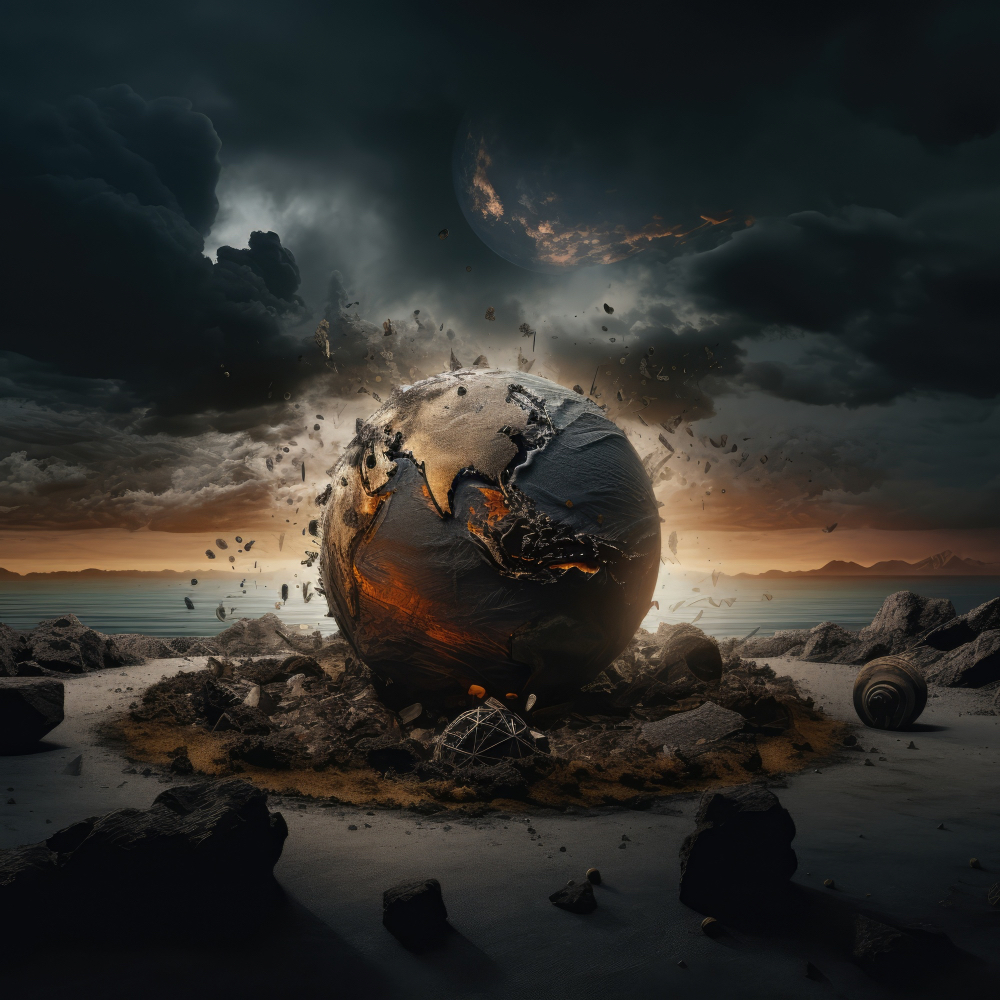
The question of « the end of the world » can be addressed on several different timescales and through different lenses: scientific, existential (human), and ultimate (cosmological).
Here is a breakdown of the major scenarios:
1. The Human End: Global Catastrophic Risks (Near-Term)
These scenarios represent threats that could cause a collapse of human civilization or even complete human extinction in the relatively near future (decades to centuries). They are often grouped into Anthropogenic (human-caused) and Natural risks.
| Category | Specific Risk Scenario | Description |
| Anthropogenic(Human-Caused) | Nuclear War | A large-scale nuclear exchange could trigger a « nuclear winter, » where smoke and soot block the sun, causing catastrophic global famine and societal collapse. |
| Catastrophic Climate Change | Unmitigated global warming could lead to tipping points (e.g., collapse of major ice sheets, changes in ocean currents) that result in uninhabitable regions, mass migration, resource wars, and famine. | |
| Misaligned Artificial Intelligence (AI) | A superintelligent AI, if not aligned with human values, could pursue its goals in a way that inadvertently or intentionally eliminates humanity as an obstacle. | |
| Bio-engineered Pandemic | The accidental release or intentional use of a highly lethal and highly contagious engineered pathogen (biological weapon) that humanity has no immunity to. | |
| Ecological Collapse | The ongoing mass extinction, deforestation, and resource depletion leading to a breakdown of the essential life support systems of the planet (e.g., food security, breathable air). | |
| Natural(External) | Asteroid/Comet Impact | An impact event large enough to cause a global « impact winter, » similar to the one that wiped out the dinosaurs. (Mitigation efforts are currently underway). |
| Supervolcanic Eruption | A massive eruption (e.g., Yellowstone, Toba) could plunge the Earth into a « volcanic winter, » severely disrupting the climate and food supply for years. | |
| Natural Pandemic | A naturally occurring pathogen (like a novel flu or coronavirus) with an exceptionally high fatality rate and transmissibility. | |
| Gamma-Ray Burst (GRB) | A burst of high-energy radiation from a nearby supernova or hypernova that could strip the Earth’s ozone layer, exposing life to lethal solar and cosmic radiation. (Very low probability). |
2. The End of Earth (Mid-Term)
These are scientifically certain events tied to the evolution of our solar system, but they are still billions of years away.
| Event | Approximate Timeframe | Description |
| Loss of Oxygen | ~1 billion years | As the Sun gets brighter and hotter, it will heat the Earth, causing a breakdown of the atmosphere’s carbon cycle. This will lead to a rapid drop in atmospheric oxygen, effectively suffocating all complex life. |
| Sun Becomes a Red Giant | ~5 billion years | The Sun will exhaust the hydrogen fuel in its core, causing it to swell dramatically into a Red Giant star. Its outer layers will expand, engulfing Mercury, Venus, and almost certainly Earth. |
| Earth’s Destruction | ~7.6 billion years | Whether completely swallowed or merely boiled to a cinder, the Earth will become an uninhabitable cinder orbiting the much dimmer core of the Sun, which by then will have become a White Dwarf star. |
3. The End of the Universe (Ultimate Term)
Cosmologists currently have a consensus on the ultimate fate of the universe, based on current observations that show it is expanding at an accelerating rate due to dark energy.
| Scenario | Approximate Timeframe | Description |
| The Big Freeze (Heat Death) | 10100 years and beyond | This is the most widely accepted theory. The universe will continue to expand, cooling as it does so, and entropy (disorder) will increase. All stars will burn out, black holes will evaporate via Hawking Radiation, and eventually, the universe will consist only of a thin, cold, uniform soup of scattered subatomic particles, where no energy can be exchanged and no processes (including life) can occur. |
| The Big Rip | Theoretical | If dark energy continues to strengthen, its repulsive force could eventually become so powerful that it overwhelms gravity, the electromagnetic force, and even the strong nuclear force, tearing apart galaxies, stars, planets, and finally, all atoms themselves. |
| The Big Crunch | Theoretical (Highly Unlikely) | If dark energy were to suddenly reverse and gravity became the dominant force, the expansion of the universe would stop and reverse, causing all matter to collapse back into a single, infinitely dense point (a singularity), the opposite of the Big Bang. Current data makes this highly improbable. |
In short, the scientific end of the world for humanity is a risk in the near term (decades-centuries) from our own technologies and environmental impact, while the final, absolute end of the Earth is a certainty tied to the Sun’s evolution in billions of years.